Page 1 of 1
addinit(v=a)
Posted: Fri Feb 02, 2024 7:57 am
by tvonbrasch
If you first solve a model, then use addinit(v=a), and then solve the model again, why can the solver then terminate?
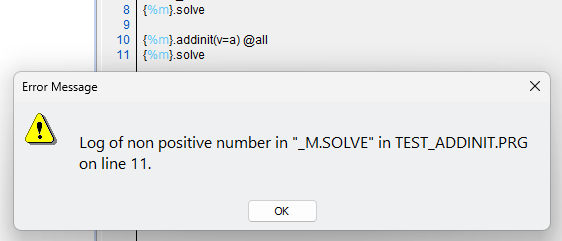
- addinit_terminated.png (13.95 KiB) Viewed 53250 times
I thought that the residuals would be set to the values they had in the first simulation when using the addinit(v=a) command. What could cause the solver to terminate when the addinit-command is used in this way?
Thomas
Re: addinit(v=a)
Posted: Mon Feb 05, 2024 9:33 am
by random_user
It seems that this is specific to the model you're using. Because I tried it on my end, and the model I was using solved successfully both times. Strange!
Re: addinit(v=a)
Posted: Sat Feb 10, 2024 8:54 am
by tvonbrasch
Hi,
Thanks for looking into this, random_user! I still don't understand the cause, but I think it is related to the actexist-option being activated.
Thomas
Re: addinit(v=a)
Posted: Mon Feb 12, 2024 6:17 pm
by EViews Matt
Hello,
It's possible that if solution values (or expressions they appear in) are very close to numeric singularities, then the adjustment of add factors combined with the solution rounding and significant digits setting could produce such failures. Here's a small program that demonstrates this effect:
Code: Select all
create u 10
series x = 3e-8
series x_a = 3e-8
model m
m.append x = x(-1)
m.append y = @log(3.3e-7 - x)
m.addassign x
m.solve
m.addinit(v=a) @all
m.scenario "Scenario 1"
m.solve
Re: addinit(v=a)
Posted: Sat Feb 17, 2024 3:20 am
by tvonbrasch
Thanks, Matt, for looking into this!