Page 1 of 1
restricted estimation different from unrestricted?
Posted: Fri May 15, 2015 10:47 am
by worldboy
I found that Eviews (8) reports different results (coeficients etc.) depending on how the equation is stated, i.e:
y c x error
or
y = c (1) + c (2)*x + error
Why is that?
Shouldn't it be the same ?
[To me it matters because I want to state a restricted equation and compare it to the unrestricted one and I have the impression that the results depend on how I write it.]
Many thanks
Best regards
Christian
Re: restricted estimation different from unrestricted?
Posted: Fri May 15, 2015 10:55 am
by startz
That would be very odd. You might want to post your exact commands and maybe your workfile with the equations included.
Re: restricted estimation different from unrestricted?
Posted: Tue May 19, 2015 2:07 pm
by worldboy
Thanks for you reply.
I thought it was odd too (EViews states explicitly in its help material, that "If there is no such restrictions, this method is identical to estimating each equation using single-equation ols." - see "System Estimation Methos OLS").
However, it yields different results even if you have only a singe equation. You can try it with an arbitrary example:

- That's the output for an usual equation:
- Example ordinarily stated 1.png (13.4 KiB) Viewed 7994 times
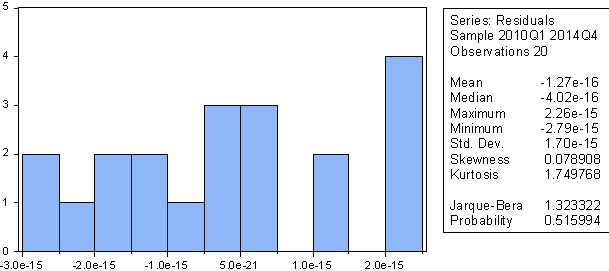
- That's for the usual equation to show that there is something differently estimated (compare to the one stated as system)
- Example ordinarily stated 2.png.gif (6.58 KiB) Viewed 7994 times
- Arbeitsmappe1.xlsx
- That are the numbers used in the example:
- (8.63 KiB) Downloaded 546 times
Ok, I can only post three attachment, so I will try to use the next poste...
Re: restricted estimation different from unrestricted?
Posted: Tue May 19, 2015 2:11 pm
by worldboy
Here I am again.
My other posts showing the same numberes done by OLS again burt stated as system:

- Example stated as system 1.png (13.99 KiB) Viewed 7993 times
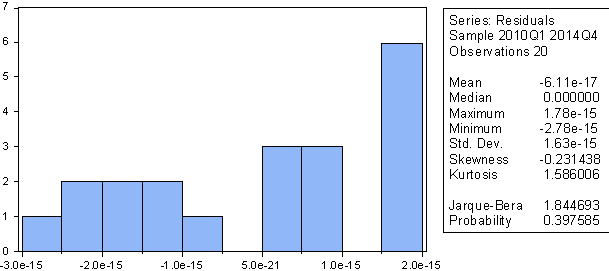
- Example stated as system 2.png.gif (5.87 KiB) Viewed 7993 times
so, am I doing something wrong - mistake - what is going on?
Thanks for replying!
Re: restricted estimation different from unrestricted?
Posted: Tue May 19, 2015 2:35 pm
by startz
Your results are identical except for rounding error. Note the RSqr = 1, so the standard errors are effectively all zero.
Re: restricted estimation different from unrestricted?
Posted: Fri May 22, 2015 2:11 am
by worldboy
Well, I have to admit, that EViews produces the same results in case of OLS. However, for other estimation methods that's seems not to be the case (here especially 2SLS or GMM). And the differences are more material than just rounding errors. I have provided an examle, please see the attached files:
Thanks again. I hope that is of more general interest.
Re: restricted estimation different from unrestricted?
Posted: Fri May 22, 2015 6:39 am
by startz
You are using a non-linear procedure. Did you reset the starting values to be the same for each estimation?
Re: restricted estimation different from unrestricted?
Posted: Mon May 25, 2015 10:51 am
by worldboy
Thanks again for answering.
I was not aware of any starting values which I could alter. However, now I looked at them and set them to zero. No change in result, I still get different outputs depending on how the equation is stated.
Also, I checked again with OLS and would still claim that the same problem / effect is present there as well (and bigger than just rounding errors).
Maybe someone from EViews should look at this? => If this is not a flaw in the program than at least something is very badly explained. I am sure I am not the only one who has encountered this problem.
Best regards
Christian
Re: restricted estimation different from unrestricted?
Posted: Mon May 25, 2015 1:11 pm
by trubador
Also;
1) EViews 9 generates singularity error when estimating the second equation.
Code: Select all
equation eq1.gmm(instwgt=hac, gmmiter=1) log(b_fr) = c(1) + c(2)*log(bunkerff) + [ar(1)=c(3)] @ log(p_msci) log(p_iore) log(p_coal)
equation eq2.gmm(instwgt=hac, gmmiter=1) log(b_fr) c log(bunkerff) ar(1) @ log(p_msci) log(p_iore) log(p_coal)
2) EViews 9 (and 8 ) seems to ignore starting values if you choose the Zero option.
Re: restricted estimation different from unrestricted?
Posted: Wed May 27, 2015 2:42 pm
by EViews Gareth
1) The EViews 9 singular matrix error will be fixed in the next patch.
2) Zero starting values will also be fixed.
Back to the original question...
The difference between these two results is due to instruments. When estimating an IV problem with AR terms in EViews, EViews will, by default, include lagged values of the regressors as instruments. However how it does that differs depending on whether you are doing estimation by list or by expression. When estimating by list, EViews adds the actual regressor (log(bunkerff)) as an instrument. When estimating by expression, since the expression may be highly non-linear, EViews can't add lagged values of the actual regressors, but instead adds lagged values of the underlying series (bunkerff).
If you click on View->IV Diagnostics->Instrument Summary, you can see the difference in the instruments used between the two estimations.
Of course using different instruments will yield different coefficients estimates.
I guess the moral is that you should always pay attention to exactly what is being estimated when you using automated tools.
Re: restricted estimation different from unrestricted?
Posted: Thu May 28, 2015 9:55 am
by worldboy
Thanks a lot.
Learned a lot.
Some times one doesn't see the forest due to the trees (as we say in German).
Maybe EViews can take this up and make the Help more explicit on this point.
Best regards
Christian